Teaching is the Highest Form of Learning
In the 1950s leaders such as Eleanor Roosevelt successfully advocated for the creation of Teacher’s Appreciation Day (May 5th) and Teacher’s Appreciation Week.1 The observance is designed to recognize the impact teachers make on shaping minds and creating educated communities.
The reason such a holiday is warranted is that the efforts of teachers often go unrecognized in our society. Most people are familiar with the derogatory adage “Those that can’t do teach,” and its corollary—”those that can’t teach–teach ‘Gym’.” This saying first appeared in George Bernard Shaw’s play Man and Superman in 1905.2 It is an insult to teachers everywhere. Aristotle coined the appropriate adage millennia before Shaw: “Those that know, do. Those that understand, teach.3”
The truth is that nobody becomes anything without their teachers. Most great achievers credit their success to at least one teacher who delivered transformative challenges and inspired the pursuit of a particular interest or career. A 2015 survey found that 88% of responders identified at least one teacher who significantly impacted their lives and 79% reportedly had a teacher encourage them to follow their dreams.4
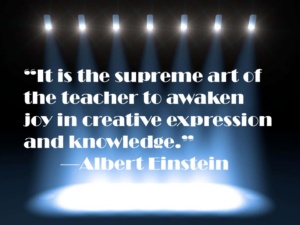
 Extraordinary teachers embody a rare ability to inspire students and deliver impact in the same way that a musical virtuoso moves an audience with a highly emotional and technical performance. Such teachers deserve the highest respect and boundless gratitude. “It is the supreme art of the teacher,” Albert Einstein once remarked, “to awaken joy in creative expression and knowledge.”
Perpetual learning through continuing education requires extraordinary teachers throughout the course of a professional career. It is the hallmark of every learned profession to create perpetual students. Every dental practitioner is influenced by an endless parade of teachers, who cover the gamut of skill in communicating knowledge and in ability to deliver impact. When an extraordinary teacher appears on the scene the effect on a professional life can be magical.
How can you become an extraordinary teacher?
 The secret to becoming an extraordinary teacher starts with an unquenchable thirst for learning. Teaching and learning go hand in hand. In order to create educational presentations and a textbook based on these presentations (now in the process of being published), I had to include hard evidence and deliver supporting evidence for the philosophical rationale behind every technique. Learning takes place during the process of these endeavors. Knowing the “why” of a specific technique may seem self-evident but explaining the “why” and the rationale of that technique is altogether different. Gut feelings are not considered adequate testimony in the scientific world.
The process of creating teaching materials such as courses, articles and textbooks ignites the spark of learning, which in turn, enhances teaching. Phil Collins captured this idea when he remarked that “in learning you will teach, in teaching you will learn.”
All of the great minds of history knew that the secret of attaining great knowledge and wisdom arises through teaching, not just through learning. High achievers who also taught include Albert Einstein, Richard Feynman, Robert Frost, J.R.R. Tolkien, Marie Curie, Stephen Hawing, J. Robert Oppenheimer, Noam Chomsky, and J.K. Rowling.
Nobel Prize winner Dr. Richard Feynman adamantly exclaimed, “I don’t believe I can really do without teaching.” He once turned down an opportunity to live at the Institute for Advanced Study on the Princeton campus.5 The inhabitants of this prestigious institute were selected for their intellect and were invited “to sit in this lovely house by the woods there, with no classes to teach, with no obligations whatsoever.” Despite this incredible opportunity, they produced no new ideas or profound insights. “Nothing happens,” Dr. Feynman explains, “because there’s not enough real activity and challenge: you’re not in contact with the experimental guys; [and] you don’t have to think how to answer questions from the students.” But student questions are often the source of new ideas and new research, Dr. Feynman explains. Students often ask profound questions.
 Aristotle maintained that “it is in the act of teaching that knowledge is shared, expanded upon, and ultimately enriched.” He understood the importance of developing “ontological empathy,” which is the ability to not only understand concepts but also to deeply empathize with them, to inhabit their essence, and to comprehend their intrinsic value. In the context of teaching, “ontological empathy” goes beyond comprehension and delves into the realm of personal connection. While understanding allows one to grasp a concept, ontological empathy takes it a step further by allowing the teacher to empathize with the learner’s journey of grasping that concept.”
But teaching is not merely an act of communicating information, Aristotle explains. “It is an art that requires a holistic approach, encompassing understanding, empathy, and emotional intelligence. By embracing these qualities, teachers can empower their students to not only know but also to truly understand and apply the knowledge they acquire,” The symbiosis of teaching and learning is the catalyst for a cycle of growth and enlightenment.6
 All great learners, therefore, can enhance their learning through teaching. Teaching does not have to be institutional—it can take the form of writing blogs, giving presentations, publishing articles and coaching others. Teaching a course is a great way to express gratitude for having acquired specialized knowledge and skills—it is a sort of educational “paying forward.” It is not important if the subject matter is elementary or advanced. What seems elementary to seasoned academics might not seem elementary to the average clinical practitioner.
Dr. Feynman was a cutting-edge pioneer in advanced quantum physics. He worked on the Manhattan project with the greatest minds ever to grace this planet, and he is considered to be one of the great thinkers of the twentieth century. Despite such lofty status, Dr. Feynman never looked at elementary subjects with disdain. In fact, he embraced them:
“If you’re teaching a class, you can think about the elementary things that you know very well. These things are kind of fun and delightful. It doesn’t do any harm to think them over again. Is there a better way to present them? The elementary things are easy to think about; if you can’t think of a new thought, no harm done; what you thought about it before is good enough for the class. If you do think of something new, you’re rather pleased that you have a new way of looking at it.7”
What qualities make a great teacher?
Teachers of Tomorrow, an organization dedicated to the teaching profession, has identified the qualities required to become an exceptional teacher: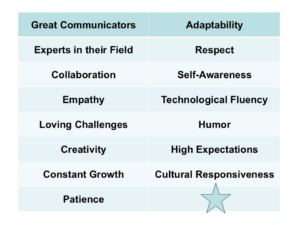
These qualities are leadership qualities! They are the same qualities required to lead a successful dental practice. In fact, the word “doctor,” actually means “teacher.”
 All practitioners would do well to view themselves as teachers—educating patients about dental health, prevention and possible treatment options if they require treatment. Doctors who think of themselves as teachers must be perpetual students because they are often required to conduct research and consult with specialists in order to find answers for their patients. But there is more: doctors who think of themselves as teachers know that there is a great deal to be learned from patients, as well as from experts in the field.
Pay it Forward
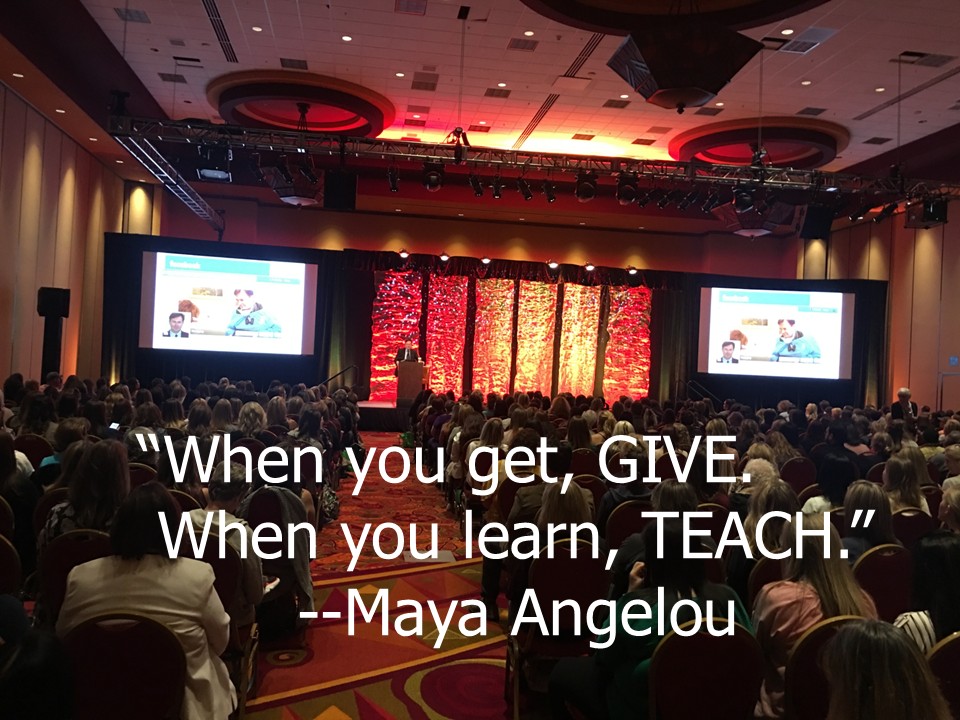
I believe the best way to observe Teacher Appreciation and to thank extraordinary teachers is to “pay it forward” through teaching. Most practitioners have expertise in a particular subject, a new technique or a novel approach to solving a difficult problem. Pay it forward by sharing that expertise with others. There are many opportunities to write articles for publications or to give courses in study clubs, dental institutions and dental associations. Or you could create your own opportunity, like I did with this blog. I look forward to taking your class.
1Becker, Lindsay; “Teacher Appreciation Day: A Look into the History of the Holiday;” February 25, 2025; https://historyoftheholiday.com/teacher-appreciation-day-history-of-the-holiday/
2Strontium; “The ‘Those Who Can’t Do, Teach’ Fallacy;” https://medium.com/@strontiumz38/the-those-who-cant-do-teach-fallacy-8116b0e12de5
4Bagley, Debbie; “The Impact of a Teacher;” Studies Weekly; March 3, 2025;https://www.studiesweekly.com/the-impact-of-a-teacher/
5Marek Druzdzel; “Richard Feynman on Teaching: The Dignified Professor;” excerpts from Surely You’re Joking Mr. Feynman!’ Adventures of a Curious Character by Richard Feynman, Bantam Books: New York, 1986; 13 May 2005; https://sites.pitt.edu/~druzdzel/feynman.html.
7Marek Druzdzel; “Richard Feynman on Teaching: The Dignified Professor;” excerpts from Surely You’re Joking Mr. Feynman!’ Adventures of a Curious Character by Richard Feynman, Bantam Books: New York, 1986; 13 May 2005; https://sites.pitt.edu/~druzdzel/feynman.html.
8Teachers of Tomorrow; “The Most Important Qualities That Make a Good Teacher,” July 17, 2025; https://www.teachersoftomorrow.org/blog/insights/good-teacher-qualities/

You may also like
Speaking of Dental Speaking…

Mentoring
