

Fringified
My name is Dr. Ed Feinberg, and I am an outlier in the dental profession!
According to dictionary.com, an outlier is defined as1 “someone who stands apart from other members of a group, such as by differing behavior, beliefs, or religious practices.”
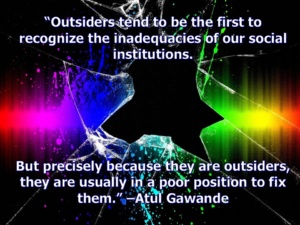 The academic world has a long-standing tradition of persecuting, marginalizing and exiling outliers who dare to think differently. Mainstream institutions position themselves as beacons of open-mindedness that welcome new ideas and inventions from every source. But all too often they serve as bastions of “group-think” and close-mindedness. Their cups of knowledge are so full that there is no room for contributions from outliers.
True learning, says commentator Sahil Bloom, begins with an empty cup mindset.2,3 Sahil tells the story of Dr. Ignaz Semmelweis. Most dentists actually know the story, because Dr. Semmelweis was first to prescribe hand washing in the 19th century to prevent the transmission of disease. Dr. Semmelweis’ protocol worked and the mortality rate at his hospital in Vienna dropped considerably. The evidence that Dr. Semmelweis was right was overwhelming and undeniable. But instead of embracing Dr. Semmelweis for his groundbreaking research, his colleagues ridiculed him and he was dismissed from the hospital where he practiced. His life down-spiraled from the unfair humiliation and he was eventually committed to an insane asylum, where he passed away at age 47.
The Semmelweis Reflex, says Sahil, “is the aptly-named human tendency to reject new evidence or knowledge because it contradicts one’s established beliefs or norms.”
 Semmelweis had to endure overt scientific censorship. But censorship today is rarely overt. David Crowe, a Calgary environmentalist and analyst of the scientific justification for modern medicine, explains that “censorship is most effective when the censor’s hand is invisible.” He notes that “modern science has developed an effective hierarchy for disseminating ‘acceptable’ information and, perhaps more importantly, for excluding work that threatens mainstream scientists and the governments and industries that fund them.4”
Who are the Fringified?
Today, victims of the Semmelweis Reflex are outliers who have been banished to sit on the fringes of their professions. They have been “fringified.” They are never taken seriously by the profession as a whole. The fringified are generally not affiliated with mainstream universities or corporate entities. They think differently and often have boatloads of valid evidence to support their hypotheses, but their evidence is automatically discounted by those standing on academia’s pedestals.
The fringified are excluded from sharing their ideas, philosophies and techniques on esteemed academic stages, major meeting venues and mainstream publications. This exclusion is subtle rather than overt, but it has all the earmarks of being a coordinated effort of censorship. Brian Martin, in his well-researched paper “The Suppression of Dissent in Science,” remarked the following:
“Most science studies analysts treat scientific discourse as relatively “free” in the sense that there are influences and incentives but no bludgeons affecting the ability of scientists to speak. The possibility of systematic squashing of speech and activity in whole areas of science in “free” societies is given little attention.5”
What constitutes evidence?
What constitutes evidence? Academicians and clinicians have very different viewpoints about what constitutes evidence for patient care. I was at a recent conference and a colleague who had seen my presentation (and someone I tremendously respect) made this seemingly innocent comment: what a shame it was that I did not have double-blind research studies for my approach to full coverage restorative clinical care. Such a statement implies that clinical evidence that does not follow academic research protocols is completely invalid.
Researchers should understand that the scientific method applied to clinical care is fundamentally flawed. Tom Siegfried, in a Science News article blows the whistle on the scientific method:
“It’s science’s dirtiest secret: The “scientific method” of testing hypotheses by statistical analysis stands on a flimsy foundation. Statistical tests are supposed to guide scientists in judging whether an experimental result reflects some real effect or is merely a random fluke, but the standard methods mix mutually inconsistent philosophies and offer no meaningful basis for making such decisions. Even when performed correctly, statistical tests are widely misunderstood and frequently misinterpreted. As a result, countless conclusions in the scientific literature are erroneous, and tests of medical dangers or treatments are often contradictory and confusing.6”
In fact, Blakely McShane and his colleagues at Northwestern University recommended in a recent article that the concept of statistical significance should be abandoned completely!7 His group is in favor of “a more holistic view of evidence” that is much more inclusive.
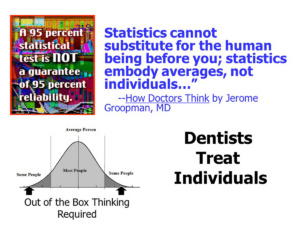 It is no secret that research studies notoriously fail to consider individual differences of patients. “Statistics embody averages, not individuals” says Dr. Jerome Groopman in his landmark book How Doctors Think.8 The patients at either end of the bell curve for a study on a particular treatment are probably not good candidates for that treatment. Optimal treatment for individuals depends on critical thinking to select the best treatment option. Some individuals may be candidates for sophisticated treatment and others may not be. It is important to have treatment options for both.
I am no stranger to academic research and the scientific method. I have peer-reviewed 87 papers for the Journal of Oral Implantology. The vast majority of research papers I have reviewed are riddled with shortcomings. There is almost always an agenda as to why the paper was written in the first place. Research is rarely conducted on the
basis of pure scientific inquiry. One of the most respected researchers in healthcare–Dr. John Ioanndis–has identified several areas where research goes wrong9:
-
- Confirmation bias: the tendency to cherry pick data, design the parameters of experiments to yield expected results, and interpret data with value judgments according to preconceived biases.
- Not accounting for confounders (outside parameters that could influence study results)
- Conflicts of interest: Confirmation bias is created by the money and interests that finance research.
- Publication bias: This is the tendency to publish only findings that don’t diverge too much from what has been published before by a publication or an institution.
- Overhyping study conclusions: Financial pressures and fundraising drives create the temptation to overstate the limitations of research results as they become part of public relations and advertising campaigns.
- Misinterpretation of data: The general public, reviewers and science journalists often ignore the tentative nature of study conclusions and hype findings that suit their interest or sensationalize news.
Science is Never “Settled”
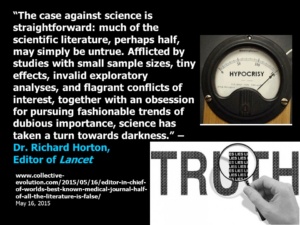 Christina Sarich, staff writer for Waking Times Magazine concludes that science is modifiable and falsifiable, just like religion. “So why have we made it the modern day, untouchable dogma?” she asks. “We can’t treat beliefs as facts, but when science is broken we do. How do we trust science again when it is so shattered? Perhaps it’s time to trust our guts again, and not every testimony given in the latest scientific journal.10”
Clinicians generally do not compile research statistics. As a clinician, I have never conducted double-blind research experiments on patients. However, I do have seventy years of documented cases that were all prepared and handled according to the same protocol. The protocol is based on sound principles of health and engineering. Many of these cases have been followed for decades WITH X-Rays. I do not know of any research studies that can match this degree of longevity. In fact, it is rare these days to see ANY follow-up for restorative cases that proves longevity in research papers or in clinical presentations. What is commonly presented is the esthetic result on the day of insertion. If the case is beautiful but fails in the long run, is that something readers or attendees should emulate? I think NOT!
By examining 70 years of restorative cases prepared according to the same protocol over two lifetimes, definite patterns emerge. It is OVERWHELMINGLY clear to anyone with an open mind that this protocol works. The sheer volume of cases validates that this protocol has an exceedingly high percentage of successful outcomes and longevity. X-Ray follow-up over decades consistently demonstrate the virtual elimination of periodontal bone loss in susceptible patients—even for patients with heart disease, cancer and diabetes! Case longevity has also been documented for patients with poor anatomical foundations such as poor root formation. Such evidence is REAL and should not be discounted because it was generated by clinicians who do not meet the seal of approval of academic statisticians.
It is an ugly stain on the dental profession that the fringified with REAL clinical evidence are systematically silenced. I have witnessed the “fringification” of several practitioners (aside from myself) over the course of my career. They often have novel solutions to clinical problems that could benefit patients, but they are shoved aside because their ideas contradict mainstream opinions or cannot be monetized. When they die, they are completely forgotten. It is as if their research and legacy never even existed.
It’s high time the profession recognize the shortcomings of research studies and statistics and adopt a more holistic approach to clinical evidence. The ADA’s definition of evidence-based dentistry seems to promote such an approach:
“The ADA defines the term evidence-based dentistry as an approach to oral health care that requires the judicious integration of systematic assessments of clinically relevant scientific evidence, relating to the patient’s oral and medical condition and history, with the dentist’s clinical expertise and the patient’s treatment needs and preferences.11”
The ADA definition clearly does not elevate research protocols and statistical analysis above clinical observation and expertise. The definition succinctly outlines the elements required to determine the best treatment options for patients. Dental practitioners should embrace all types of evidence with an open mind in order to enhance their knowledge and skills.
One of the shortcomings of dental education is not that they teach techniques that I disagree with, but that they indoctrinate students into thinking that they were given all of the answers. They fail to remind students that there are different approaches to patient care that cannot be covered in dental school curricula because of limited time. Some professors are so ego-centric that they tend to protect their “turf” from outsiders who might upstage them with clinical techniques they know nothing about. Students tend to idolize their professors, so it is important that they serve as role models who encourage open-mindedness and learning.
I am seeing students graduate from dental schools with closed minds who believe that dental science is “settled”—that what they are taught is the only way and the best way to practice dentistry. Nothing could be further from the truth.
I have heard new graduates profess to know more than they actually do. Some even profess to know more than their highly experienced older colleagues! They consider themselves to be digital experts, since they grew up in the age of technology. New practitioners have no idea where dentistry came from, so they are deluded about their level of knowledge and skills no matter how proficient they are with computers. Older practitioners have a tradition of adapting to new technologies, and many are equally proficient with computers. Age is not a limiting factor when it comes to learning about new technology.
Experienced practitioners know that digital dentistry has shortcomings and that optimal full coverage restorative dentistry cannot be accomplished solely with digital techniques at this point in time. Recent graduates do not understand that not all technology is good technology. Technology that violates basic protocols that have proven successful in the past is NOT an advancement.
It is critically important that all practitioners understand that technology is a tool, not an end in itself. Dentists are responsible for the outcome of treatment, not the means by which they arrived at that outcome. Unfortunately, today’s dentists tend to be more obsessed with economics and workflow, than with health and longevity as they were when I started my career. So, despite all the new technology, the overall quality of full coverage restorative dentistry has actually declined. When it comes to full coverage restorations, today’s dentists know less and can do less than their forbears. THAT is what I see!
Dentists who have delusions about their level of knowledge and skills are not even aware that they are providing substandard or malevolent patient care. Perhaps this is one reason that I am seeing an absolute epidemic of surgical implant therapy. Teeth that can easily be saved with conventional techniques are being routinely extracted in order to place implants—as if implants were panaceas and the answer to every restorative problem! Patients are rarely offered choices when treatment is presented these days, and they are often pushed into overly invasive and expensive treatments that are likely to fail. The reputation of the profession is rapidly sinking to the bottom of the ocean.
Education is Key
Education is the key to keeping the profession’s “ship” afloat. Education does not end on graduation day; it begins on graduation day. Continuing education must be a lifelong pursuit. Academic institutions and major meeting venues have a duty to present balanced curricula, and NOT cater to popularity or funding by corporate entities.
Empty your Cup
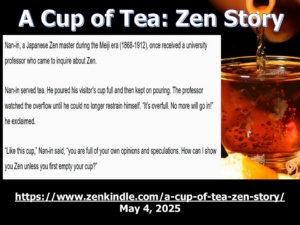 Joe Hyams, an accomplished martial artist, emphasized that in order to learn something new, it is essential to “empty one’s cup”—in short, to empty the mind of bias and preconceived notions. He devoted an entire chapter to this concept in his book Zen in the Martial Arts.12 His teacher was Bruce Lee, and he explains that emptying his cup was necessary to make room for new learning. This practice, he remarked was “[his] first real lesson in Zen in the martial arts and its application to life—although at the time [he] didn’t recognize it as Zen. It was merely good sense—which is what Zen really is.”
The Zen practice of emptying one’s cup stimulates the ability to view challenges from new perspectives. I also learned to empty my cup when I studied martial arts many years ago. I began my martial arts training with Tae Kwon Do—a “linear” art that consists mostly of kicks and punches. Several years later I decided to study Hapkido—a “circular” art that consists mainly of hand grasps and throws. I had to empty my cup filled with linear thinking in order to embrace that art. In fact, I practically had to “unlearn” my entire martial arts training in order to retrain my mind for a completely different approach. Later in my martial arts training, I was able to perform sequences that combined both Tae Kwon Do and Hapkido techniques. Now that is Zen!
The Zen concept is directly applicable to the dental profession. Dental practitioners should approach new ideas with a cup empty of preconceived notions. Becoming a Zen master of dentistry means mastering the ability to embrace alternative perspectives and ideas that deviate from accepted mainstream practices.
A Zen master also wields the ability to bridge the gap between academic ideas of “evidence” and clinical ideas of “evidence.” Both have merit and both have shortcomings. But the strongest case can be made for a particular protocol when evidence is presented from both arenas. Neither arena should ever be discounted.
George Orwell once said that “however much you deny the truth; the truth goes on existing.” I speak the truth and no amount of ridicule or fringifying will ever render truth irrelevant. The truth is that full coverage restorative dentistry as it is currently taught does not compare to the 70-year protocol developed by my father, myself and my father’s mentor. If true advancement is to occur in science, anything new that comes down the pike MUST be compared to the standard that came before. The truth is that such a comparison has NEVER been done. No amount of fancy technology can compensate for this gross dishonesty.
The great philosopher Arthur Schopenhauer once commented that “all truth passes through three stages. First it is ridiculed. Second, it is violently opposed. Third, it is accepted as being self-evident.” But in order to pass through these stages, new ideas must be given the opportunity to be heard on academic stages, at meeting venues and in publications. The fringified often have boatloads of valid evidence for new ideas, philosophies and techniques that have the potential to revolutionize dental practice, but they are denied this opportunity. Even three lifetimes of evidence (which is what I have to offer) can be for naught. The sad reality is that once the label of “fringified” sticks, it is almost impossible to wash off.
1https://www.dictionary.com/browse/outlier
2Bloom, Sahil; “The Empty Cup Mindset;” April, 2026; https://www.sahilbloom.com/newsletter/the-empty-cup-mindset
3Hyams, Joe; Zen in the Martial Arts; Bantam Books, New York; 1979; p. 12.
4Crowe, David; “How Scientific Censorship Works;” Alive Magazine; November, 2003; http://www.skeptiko-forum.com/threads/how-scientific-censorship-works.1592/.
5Martin, Brian; “The Su1ppression of Dissent in Science;” Research in Social Problems and Public Policy, Volume 7, 1999; http://mindfully.org/Reform/Suppression-Dissent-Science.htm
6Siegfried, Tom; “Odds are It’s Wrong: Science fails to face the shortcomings of statistics;” Science News; Vol. 177, #7; March 27, 2010; p. 26; https://www.sciencenews.org/article/odds-are-its-wrong
7McShane, Blakeley; Gal, David; Gelman, Andrew; Robert, Christian; Tackett, Jennifer L; “Abandon Statistical Significance;” THE AMERICAN STATISTICIAN;
2019, VOL. 73, NO. S1, 235–245: Statistical Inference in the 21st Century
https://doi.org/10.1080/00031305.2018.1527253; https://www.tandfonline.com/doi/full/10.1080/00031305.2018.1527253#abstract
8Groopman, Jerome MD; How Doctors Think, Mariner Books, Houghton Mifflin Company, 2007; P. 6.
9Ionnadis, Dr. John; “Why Most Published Research Findings are False; JPA; PLoS Med; 2(8): e124. doi:10.1371/journal.pmed.0020124; August 30, 2005.
10Sarich, Christina; “6 Reasons Why Most Scientific Research is Fake, False or Fraudulent;” Waking Times; http://www.wakingtimes.com/2016/04/21/6-reasons-why-most-scientific-research-is-fake/; April 21, 2016.
11ADA Policy Statement on Evidence-Based Dentistry; https://www.ada.org/resources/research/science/evidence-based-dental-research
12 Hyams, Joe; Zen in the Martial Arts; Bantam Books, New York; 1979; p. 12.


You may also like

The Zirconia Scam

What’s the Deal With AI?
