

Mentoring
What is a Mentor?
 According to Wikipedia1, “A mentor is someone who teaches or gives help and advice to a less experienced and often younger person.” A mentor’s purpose is to guide and influence the personal and professional growth of a mentee. In this way, information is passed on to the next generation of professionals. Most mentorships consist of senior and highly proficient practitioners mentoring junior novices, such as recent graduates. However, mentors do not necessarily have to be older than the mentees. What matters most is ensuring that accumulated knowledge and skills is passed on to others instead of being lost to the slag heap of history. I believe that mentorship is the ultimate hallmark of professionalism. Practitioners who have achieved extraordinary skills and excellence have a duty to elevate and inspire others.
Edward Hoffman PhD of Psychology Today Magazine says that “mentorship is a uniquely important human relationship spanning millennia and cultures. Even a casual perusal of art, music, literature, and science shows how mentorship has nurtured creativity and inspiration.2” Dr. Hoffman explains that “although many people go through life without ever experiencing this special bond, mounting evidence shows major psychological benefits for both participants [mentors and mentees].”
What’s in Mentorship for Mentors?
Mentors not only pass on the knowledge and skills they accumulated over a lifetime; they elevate mentees to develop greater confidence and self-esteem, to become leaders, to acquire career focus and to enhance their overall well-being. Mentors ensure that their dental practices will be passed intact to individuals who truly care about the patients and embrace the idea of carrying on the tradition that they created. The ability to share perspectives on patient treatments and professional issues with a mentee is both stimulating and life-changing for both mentor and mentee.
What’s in Mentorship for Mentees?
No one is equipped to go into private practice fresh out of dental school. The education provided by dental schools is rudimentary at best. New graduates should understand that their real education begins the day they graduate. What better way to begin one’s dental education than to find shelter under the wings of a mentor? A good mentor will do everything in his or her power to elevate the mentee with knowledge and skills—not just with clinical techniques, but with business and practice management strategies for success as well.
 New graduates often suffer silently with “imposter syndrome” (aka the Jonah Complex) as a result of their inexperience. A mentor can provide much-needed emotional support and encourage them to achieve greater self-confidence and direction. Mentors nudge mentees out of their comfort zone in order to stimulate professional growth. Newbies should expect to make mistakes—and they should recognize that mistakes are unpleasantries essential to the learning process. Having a mentor onsite to correct those mistakes offers tremendous peace of mind, as well as an opportunity to learn “what NOT to do.”
Isaac Newton once said, “If I have seen further than others, it is by standing on the shoulders of giants.” Sahil Bloom expounded on this famous statement in his Curiosity Chronicle blog.3 He explained that giants have to bend down and provide the “lifting” energy. Sahil noted that the people who can change lives have high shoulders. “They can see the truth of your capability and potential. They believe you’re capable of realizing it. And they’re willing to lift you up onto their shoulders so you can.”
My Mentorship Experience
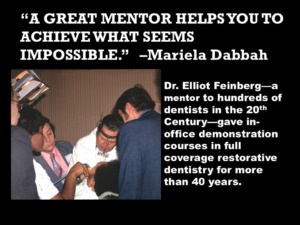 I grew up in Dentistry. My father was a master and pioneer of crown and bridgework and full mouth reconstruction. He was my mentor, and he had the highest shoulders of any dentist I have ever known. He was way ahead of his time. He also was a tough taskmaster with stratospheric expectations. But he was not only tough on me, he was even tougher on himself. He always said that “one of the toughest things in Dentistry is to be your own worst critic.” I saw him do work over that I know nobody would do over.
But today I see so many dentists rationalize shortcomings in the name of economics and workflow. It seems common to accept work that isn’t one’s best. Dentists must realize that bacteria are microns. The likelihood of getting away with errors is slim. High standards are a must if the goal is to achieve excellence with a high percentage of successful outcomes.
When I started working with my father, I spent most of my time assisting him at the chair and watching everything he did. That’s how I learned how to become a great clinician! I carved all of the provisional splints for his patients, and I also spent hours after the patients left in the laboratory preparing the models for the technicians. I sat in on all of the treatment plan presentations. After hours, I was responsible for all the patient emergencies. The patients became comfortable with me and eventually accepted me as an excellent practitioner in my own right.
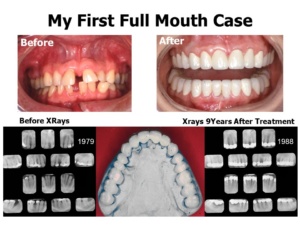 My father also lined up patients who needed full mouth cases for me to work on. Most dentists wouldn’t even attempt such cases until they were in practice for at least ten years. But my father was going to check every step and ensure that every procedure was accomplished properly. My first patients received a tremendous break in the fee, and they basically paid only for the laboratory work. I had to prepare 32 teeth on my very first patient! “Beginner’s luck “ set in and by some miracle every step was executed flawlessly! (I found out later that this is not always the case). Because I concentrated on quality rather than speed, I was a very slow practitioner at the beginning of my career. But as I became better, I became faster.
My mentor and I went on to practice together as dentists for 23 years. We would often discuss treatment plans, new developments in dental treatment, and issues affecting the profession. Together we amassed 70 years of documented cases—all created according to the same basic principles. Our cases were followed for decades WITH X-Rays. This level of documentation is an absolute rarity! The vast majority of articles and presentations do not present ANY follow-up. Both my father and I wrote textbooks, and I am in the process of publishing a second textbook.
When my father passed away, I retained 100% of the patients. They all knew and trusted me, and they knew they were going to receive the exact same quality and care that my father was famous for.
Why Don’t Today’s Practitioners Want Mentors?
 I sold my practice a few years ago to a fine young practitioner who was already expert in placing and restoring implants. I really thought that I was going to be a mentor to him in the way that my father was a mentor to me. However, it soon became apparent that he did not want to learn anything from me. Like so many practitioners of his generation, he only wanted to place and restore implants. I had a crown and bridgework practice, and I wondered why he even bought my practice. He could have had it all, and he was foolish enough to let me leave his practice. He also did not understand that I had a long-standing relationship with the patients. Because he did make the effort to know my patients and earn their trust, I’m sure he lost the majority of them once I left.
Despite that disappointment, I still yearn to be someone’s mentor! But to this very day I have not found a single practitioner who wants one—and this sad reality is as true for Arizona as it was for New York State. In a million years I would never have believed that my clinical expertise would not be valued by younger generations. At the beginning of my career most practitioners would have given their “eye teeth” to have someone like me to mentor them.
 Liz Elting of Forbes Magazine, notes that the majority of Gen Z-ers go without a mentor, even though surveys show that they understand the importance of having a mentor.4 Gen Z is projected to be the largest generation in the workforce by 2035. Ms. Elting notes that Gen Z-ers struggle with “soft skills” such as communication, problem-solving, creativity and empathy.
Many practitioners have an attitude that they are knowledgeable enough because they are adept at using computers. Anything they need to know they believe they can learn on YouTube. Nothing could be further from the truth! One could never acquire the level of knowledge and skills from YouTube that I attained from a lifetime of clinical experience and collaboration with mentors.
Perhaps the most obvious reason why dental school graduates fail to seek out mentors is that they are saddled with crushing school loan debts. I know of a new graduate here in Arizona who is starting her career with a debt in excess of $700,000. Naturally, her priority is not to seek out a mentor, it is repayment of that enormous debt. She is forced to adopt a “production” mindset when she is not ready to do so. By contrast, I did not have any debt when I graduated from dental school, so I could concentrate on building my knowledge and skills with a “quality” mindset. In order to achieve excellence, a quality mindset is essential from the getgo, because it is ingrained in your values and in the essence of who you are and who you want to be. One cannot simply say, “I’ll do production now, and then do quality later.”
Conclusion
 Doug Flaig, CEO of Stratus Building Solutions and Forbes Magazine contributor, notes that “the power of mentorship lies in its ability to transform individuals, organizations and even industries. By investing in the growth of young professionals, mentors leave a legacy of leadership that extends far beyond their tenure.” Mentorship, says Mr. Flaig, is a “timeless strategy” for building the next generation, and “ensuring a future where growth, innovation and success thrive.”
There is an ancient saying from Zen Buddhism and European occultism:
“When the student is ready, the teacher will appear.6”
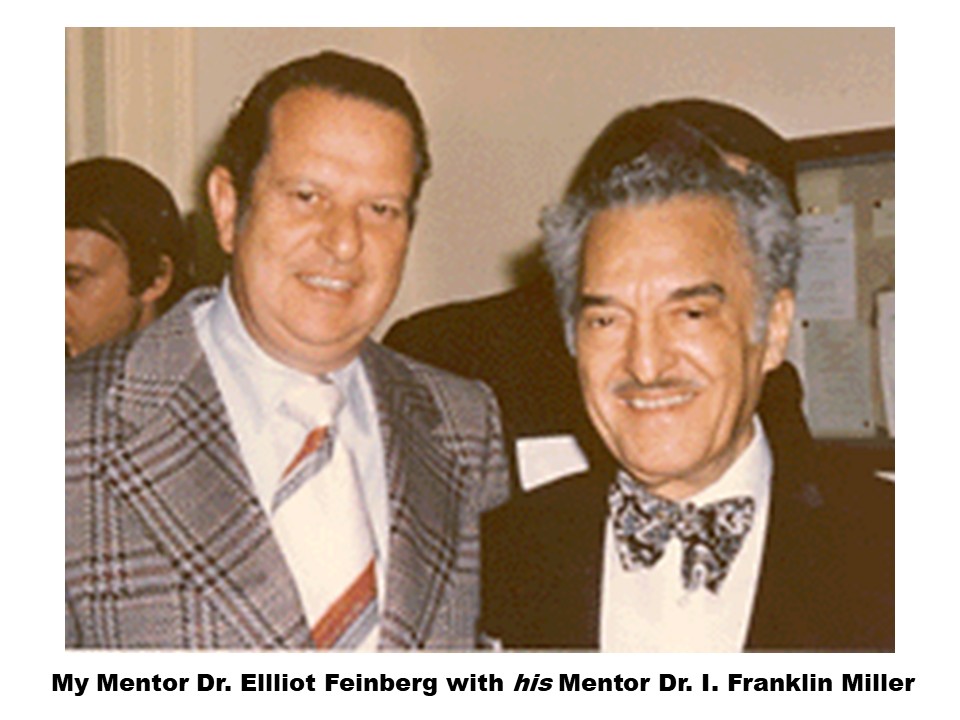
The reality is that mentors don’t mysteriously drop from the heavens when a student decides that he or she is ready. The student has to actively seek out the mentor. My father decided early in his career that he wanted to be THE best dentist. He sought out teachers and found a mentor in Dr. I Franklin Miller, a brilliant pioneer of full coverage restorative dentistry. Dr. Miller inspired my father to become my mentor. In this way priceless knowledge and experience has been passed down through generations.
However, if I can’t pass this information to others, our collective legacy will go by the wayside—and that would be a tragedy for Dentistry. The profession is hereby given notice:
The mentor is ready…will the student appear?
1https://en.wikipedia.org/wiki/Mentorship
2Edward Hoffman Ph.D. Hoffman, Edward Feinberg PhD; “Why Mentorship Matters In the contemporary workplace, it’s more important than ever;” April 8, 2026; https://www.psychologytoday.com/us/blog/the-peak-experience/202604/why-mentoring-matters\
3Bloom, Sahil, Curiosity Chronicle; “The High Shoulders Theory;” https://www.sahilbloom.com/newsletter/the-high-shoulders-theory
4Elting, Liz; “Gen-Z Faces A Mentorship Gap. What Companies Can Do To Help Close It;” Forbes Magazine; December 11, 2025, 5:45am EST; https://www.forbes.com/sites/lizelting/2025/12/11/gen-z-faces-a-mentorship-gap-what-companies-can-do-to-help-close-it/
5Flaig, Doug; Forbes Magzine; “The Power Of Mentorship And Building The Next Generation Of Leaders;” Feb 28, 2025; 7:30am EST; https://www.forbes.com/councils/forbesbusinesscouncil/2025/02/28/the-power-of-mentorship-and-building-the-next-generation-of-leaders/


You may also like
Speaking of Dental Speaking…

Teaching is the Highest Form of Learning
