
Speaking of Dental Speaking…
I have been a public speaker for most of my career in Dentistry. For the last 35 years, I have been giving presentations to dental audiences all over the country. It is my mission to help my dental colleagues because I received a unique gift by birthright. This gift is priceless, and I feel strongly that it is my duty to share it with others—especially since so many of my colleagues are having difficulty with crown and bridgework.
What is this gift? It is the training I received from Dr. Elliot Feinberg, my father and mentor. My father was an absolute master in full mouth rehabilitation and full-coverage restorative dentistry. He was way ahead of his time, and he mapped the route that full-coverage restorative dentistry must take if there is ever going to be true advancement in the field.
As a teenager, I already knew the career path I was destined to follow, and I raced through my education to became a full-fledged dentist at the age of 24. I was one of the youngest graduates in my class. I was somewhat immature, having very little worldly experience. After completing a residency at Bronx Lebanon Hospital, I joined my father’s practice in Scarsdale, NY.
 My father immediately enrolled me in the Ninth District Dental Association. He was a past president, and a staunch supporter of organized dentistry. Of course, being my father’s son, everyone assumed that I must be equally adept and charismatic. Little did they know that I was hanging out at the opposite end of the prodigy spectrum. No sooner was I enrolled; I got “volunteered” by Ninth leaders to serve on the Membership Committee.
In my first year on that committee, I contributed absolutely nothing. Despite this fact, the officers appointed me chairman of the entire committee the very next year! Horrors! What were they thinking?! I was forced to step up to the plate. I didn’t want to be an embarrassment to my father or besmirch the family name. I guess their gamble paid off. I remained as Membership Committee chairman for the next 17 years.
My father was a larger-than-life public speaker. In addition to his skills and knowledge, he was admired for his captivating presentations and charisma. By contrast, I had an acute case of “glossophobia (fear of public speaking).” I cowered whenever I was called upon to speak in public. I was a terrible speaker. But my dad confided in me that he wasn’t a great speaker when he started. He pointed out that speaking skills are acquired and not genetically endowed. In fact, Ralph Waldo Emerson concluded that “all the great speakers were bad speakers at first.”
As Membership Chair, it was my duty to orient the new members joining the Ninth District. I was supposed to enlighten them about the dental association and make them feel welcome. The orientations at that time took place at evening board meetings in a room adjacent to the boardroom of Ninth District Headquarters. It was the custom for the membership chair to whisk several board members from their meeting and deposit them in front of the new members. Needless to say, they did this begrudgingly because they really didn’t like being interrupted during the course of their meeting. But once they were there, they would talk to the new members about various dental issues and aspects of the association.
I did not feel comfortable with this arrangement. I realized that this method of orientation didn’t really communicate anything about the dental association and what benefits and services were available to them. I felt awkward because I could not fill in the gaps. I knew exactly squat about the dental association. I could not even answer the most basic questions!
I hated looking inept and unprepared. One of the keys to becoming a great speaker is to simply be prepared. So, I came up with the idea of creating a New Member Orientation Slide Carousel that thoroughly covered the benefits and services of national, state, and local branches of the tripartite American Dental Association (The Ninth District is a component of the New York State Dental Association and the ADA).
 PowerpointTM would have made this task easy, but there were no computers in those days. Presentations were typically conducted with slides in carousels. I embarked on an extensive research project about the dental association, and I organized the benefits and services into an outline for the presentation. My committee members and I then created 100 posters illustrating these benefits and services by hand. We cut and pasted pictures and text from journals and magazines and applied them to poster boards of different colors. When the posters were finished, Dr. Don Einbinder, the Ninth’s photographer, met me at Ninth District Headquarters to photograph the posters to make slides. I hung each poster on the wall and he photographed it. Later, we added some title slides to the presentation that were professionally fabricated.
When the slide carousel was complete, I arranged for the new members to be inducted during general meeting luncheons instead of at the evening board meetings. New members inducted this way had the opportunity to experience the Ninth’s first-rate continuing education program. At the luncheon, they were introduced individually to their new colleagues, and they were treated to Ninth District hospitality and camaraderie.
 After lunch I escorted the new members to an adjacent room and delivered the slide orientation program. The membership orientation was impressive and instrumental in retaining those new members.
I gave that presentation so many times that I quickly became adept at giving it. Once I felt confident and prepared, I began to love conducting the new member orientations. I looked forward to them! It’s funny how a little preparation and practice can make such a huge difference in public speaking.
Speaking about membership to speaking about other topics was not such a great leap. I started giving presentations about Dentistry to Rotary club meetings, BNI meetings, Chamber of Commerce meetings, senior centers etc.–anywhere I could be invited. I also started to give scientific presentations for the Ninth District’s local study groups. Soon I was giving all-day presentations at major continuing education venues throughout the country.
 I created a teaching website–www.theONWARDprogram.com–that allows me to teach colleagues all over the world. I strive for continual improvement of my speaking abilities each time I create a new course for the website. So far I have created more than 35 video courses. I continue to update the existing courses and create new ones.
I don’t like giving canned presentations, so no two presentations I give are the same. I strive to make every one of my presentations unique and custom-tailored to each audience. Over the years I developed my own unique style. I continue to hone my craft–and I want each presentation to be an improvement over the one that preceded it.
My friends and colleagues are amazed that I am able to give six-hour presentations and never cover all of the material that I bring with me. Most of them shrink at the thought of speaking in public. Jerry Seinfeld once joked that fear of public speaking (aka glossophobia) is the number one fear. “People are more afraid of speaking in front of crowds than they are of death! This means,” he exclaimed, “that if you go to a funeral, you’re better off in the casket than doing the eulogy.”
I’m often asked by my glossophobic friends, “Do you ever get nervous?” The answer is “Heck yes!!!!” If I didn’t have a little bit nervousness, I wouldn’t be any good. The nervousness shows that I deeply care! I desperately want my audience to get the most out of what I have to show them. I want them to take information home that they can use immediately in their practices. And most of all, I want my presentation to be a “hit” in their eyes so I can get “good reviews.”
 But once I am on the podium, I relax and the nervousness vanishes. I like that feeling of having the audience in the palm of my hand, riveted to my every word. I know they have NEVER seen anything like what I am showing them—their eyes widen when they see cases that they think are impossible. The sheer volume of cases I show with X-Ray follow-up over decades is mind-blowing! Very few speakers ever show anywhere near this level of documentation. Case examples that support the basic principles that I teach span 70 years of my career and my father’s career!
Robert Moment—the author of How to Succeed in Life, believes that “Fear of public speaking can be overcome with effective public speaking tips, skills and strategies.” He is right. To sharpen my speaking skills, I have taken numerous courses in speaking and delivering presentations. I learned a great deal from Vanessa Emerson’s Dental Speaker Conferences, and she introduced me to amazing speakers on every imaginable aspect of dental speaking.
While I have had instruction from many great speakers—two stand out as having made the most impact. Mark LeBlanc, who runs a speaking business based in Minnesota, is a master at connecting intimately with each individual in his audience. Mark is the only dental speaker in all my years of attending continuing education courses who received a thunderous standing ovation (without asking for one).
Currently, I meet online every month for instruction on how to be a better speaker with Patricia Fripp, a brilliant and renowned speaker (and also a former NSA president), who has a fantastic teaching website (https://fripp.com/) that outlines a protocol for becoming a great speaker. She offers numerous tips and tricks about how to open, structure, and close a presentation, as well as how to tell stories for maximum effect. Thanks to her, I am a better speaker, and I continue to improve as I meet with her monthly. Naturally, I am a huge fan of hers!
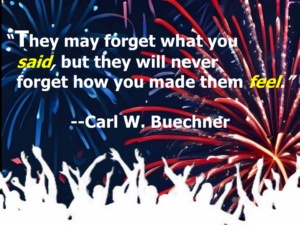
Carl Buechner once said that the audience “may forget what you said, but they will never forget how you made them feel.” That is so true. I want desperately to connect with my colleagues on an emotional as well as an intellectual plane. I include human-interest stories about the patients whose cases I am showing. After all, they are real human beings whose stories have touched me emotionally!
 Mark LeBlanc noted in one of his presentations that speakers must be speaking consistently if they really want to shine. When he started his career he strived to speak as often as possible, and often his talks were delivered free of charge. In this way he honed his craft in front of audiences. Eventually he became a highly sought-out speaker. That’s what I strive to do as well.
One of the easiest ways to practice public speaking is to become a podcast guest. I subscribe to podmatch.com, a website that matches speaker hosts with podcast guests for a nominal monthly fee. I have made at least 45 appearances a guest on both dental and public podcasts. I listen to each podcast when it is released. That’s where I catch myself making speaking “no-nos”–like saying too many “ums.” Did I explain myself clearly and concisely? At the next podcast I make a conscious effort to correct those mistakes and do better.
Serving as a podcast guest allows me to communicate my mission to both dentists and patients. My mission for patients is to give them insight into what can be done in dentistry. Patients accept that medical doctors differ in knowledge and skills and they often seek alternative medical opinions. But when it comes to dentistry, they usually don’t ask questions, and they just do whatever their dentist tells them. There is a trend for dentists to recommend overly invasive treatments. Patients should understand that dentists are no different than physicians; they cover the gamut of knowledge and skills. If one dentist can’t save teeth, perhaps another one can. If one dentist’s treatment plan is overly invasive, perhaps another can offer an alternative approach. Patients should not hesitate to seek out second dental opinions.
My mission for dentists is to upgrade their knowledge and skills about full coverage restorative dentistry. It pains me to see so many of my colleagues having difficulties with crowns and bridges. The problems they are commonly experiencing were actually solved in the 1930s! I can also enlighten dentists with new treatment options for patients that they have never considered and teach them how to save teeth that they are currently extracting.
Here are some pointers for anyone looking to improve public speaking1:
- Speak on topics that reflect your expertise and that you are passionate about.
- Be prepared. Include visual aids such as PowerpointTM to help you remember talking points.
- Include stories (and patient cases) that illustrate your talking points and touch your audience.
- Take courses in public speaking: Have experts teach you to become a better speaker.
- Practice, Practice, Practice!
- Evaluate your speaking performances: Record yourself and consciously strive to correct your speaking errors.
- Work on proper breath control. Learn how to relax on stage. Apply principles of meditation and positive affirmations. Pause your speech where appropriate for maximum impact.
- Drink water when your throat becomes dry.
1https://www.briantracy.com/blog/public-speaking/fear-of-public-speaking/


You may also like

Mentoring

Teaching is the Highest Form of Learning
