
Whatever Happened to Science?
Whatever Happened to Science? Science was once conducted for pure curiosity and benefit to humanity. The practitioners that were most admired were true scientists. A great example of a true scientist in the dental profession is Dr. Per-Ingmar Brånemark, the great researcher who invented the osseointegrated implant. He dedicated his life to the quest for knowledge in order to benefit humanity. He conducted more than 20 years of studies on animals and totally edentulous humans before he brought his invention to this country in the early 1980s. Practitioners knew that if they followed his protocols they could obtain the same level of success that he obtained.
Today, it seems that the quest for truth in science has taken a back seat, while self-serving interests rule the roost. Financial rewards and status are idolized rather than knowledge, skills and accomplishment. No field in the science arena has escaped these agendas—and that includes the science of Dentistry. Many respected practitioners and researchers have been seduced by the rewards of money and prestige. But becoming caught in an ethical dilemma does not preclude them from being idolized.
Patrice Lewis hits the nail right on the head in her essay, “I Wanted to be a Scientist1”:
 “We tend to elevate scientists to towering status because they possess great knowledge and have the ability to draw conclusions based on unbiased data. We think just because someone has academic credentials, his methods are sound, his ethics above reproach and his conclusions infallible.”
After reviewing about 90 papers for the Journal of Oral Implantology, it is abundantly clear to me that almost every paper is submitted with an agenda–a reason why the paper was written in the first place. Rarely is pure scientific curiosity a motive for research studies. A popular saying advises readers to “follow the money2,”and many agendas will become exposed. For example, who would ever trust data concluding that smoking is harmless from a study conducted by tobacco growers? Likewise, it is reasonable to assume that studies funded by government will only conclude what government wants seen—regardless of truth.
I believe strongly that almost all practitioners start their careers with idealistic intent. But most fall prey to the dark agenda of economics. Their downfall begins with the outrageous debts incurred from dental education. One recent graduate from a dental school in Arizona confided in me she has educational loans in excess of $700,000! By contrast, I had no debt when I graduated from dental school.
New graduates should concentrate on building knowledge and skills, since dental schools can only provide a rudimentary foundation for learning in such a short time. Real learning is a lifelong endeavor that begins on graduation day. Instead, new graduates with crushing debt are forced to concentrate on “production” in order to pay back the enormous loans. The pressure to “produce” prevents them from ever living up to their true idealistic potential.
Dental education also indoctrinates students with dogma and misconceptions. Dental schools and institutes—rather than being open-minded centers that promote learning—are actually political institutions, where instructors toe the line (conform to established ideas) and department chairs “protect their turf” from outsiders who might know something out of their wheelhouse. As a result, students are not taught by their role models to be critical thinkers or to appreciate alternative perspectives in the dental profession.
In my area of dentistry—full coverage restorative dentistry—students are not provided with any historical context whatsoever. If they were, they would realize that the techniques they are taught do not at all stem from what came first. Worse yet, they do not even compare favorably! As a result, today’s generation of dentists does NOT enjoy the great track record of success of their forebears—even with all of the fancy new technology. Sad to say that the problems dentists currently experience with crowns and bridges—restorations falling out and recurrent decay–were actually solved in the 1930s! Is it any wonder that so many dentists are turning away from saving teeth with crowns and bridges in favor of extractions and implants?
 There is a disturbing trend corrupting all of the sciences: theories tend to be accepted as gospel fact the longer they are around—even when there is no supporting evidence whatsoever. Observations that conflict with prevailing “wisdom” are often discarded as “anecdotes” or “anomalies” to protect the theory. Sometimes, data is statistically manipulated to reinforce belief. Outside-the-box solutions to problems tend to be pooh-poohed with their proponents marginalized to the “lunatic fringe.” Who will ever forget Dr. Anthony Fauci’s admonition to “trust the science” and turn a blind eye to the poison vaccines? Real science is NEVER settled and ALWAYs open to challenge.
In full coverage restorative dentistry, for example, there is a misconception that is widely promoted about the amount of room required for the gingival attachment. A famous study conducted by Gargiulo and Wentz in 1961 reported that 2.06mm was necessary for the gingival attachment that connects the root surface to the periodontal bone.3 Dr. D. Walter Cohen coined the term “Biologic Width” for this measurement in 1962.4
To this day most practitioners accept the results of this study as gospel fact. But dentistry’s clinical forebears knew this measurement was erroneous! Before the term “biologic width” was ever coined, they were taking impressions of the entire root surface with copper bands. No one worried about impinging on the gingival attachment, and the success of dentistry’s first full coverage restorations—gold with processed acrylic facings—is well documented.
The margins of restorations that came from dentistry’s roots extended beyond the shoulder onto uncut tooth structure. This arrangement simulates a Mason Jar cover,–the best means of food preservation ever devised–so recurrent decay was a rarity. The restorations also obtained a firm grip on the root surface below the gingiva, so they exhibited superior retention and almost never dislodged or required periodic re-cementation. My father and I (and my father’s teacher Dr. I Franklin Miller) prepared thousands of teeth with this concept over nearly a century, and the overwhelming majority of cases lasted at least 10 years—even on individuals who were highly susceptible to decay or had systemic diseases like heart disease, cancer, and diabetes.
 Today, I hear practitioners protesting loudly about utilizing the root surface below the gingiva. They continually squawk about violating biologic width, even though their hygienists are routinely sticking their curettes into the gingival attachments with no adverse effects.
Clinically the violation of biologic width is rare, and usually only occurs when the shoulder (ledge) is physically at the same level as the bone so that there is no room for a ferrule. With techniques that came from dentistry’s roots, crowns and bridges are worn for a trial period before permanent cementation with rubber or Vaseline™ ointment (that is how well they fit—they do NOT fall out). Only once in a great while does a margin have to be shortened because it is too long and interferes with the gingival attachment.
Dentists have been indoctrinated to look down on anyone who uses copper bands/aluminum shells for individual impressions or provisional restorations. The use of copper bands came from the roots of full coverage restorative dentistry. “Groupthink wisdom” teaches that copper bands are “old fashioned,” and only used by “dinosaurs.” The sad reality is that the accepted “modern” technique with retraction cord and elastic materials CANNOT register an impression of the ENTIRE root surface below the gingiva and above the bone. It is simply not possible to get the elastic material far enough down the root surface. I have heard through the grapevine that a special scanner has been invented to register the entire root surface above the bone, but it is not yet available on the market. Such technology would be a game changer. It is important to recognize that the method employed is less important than satisfying the basic principle of registering a complete impression of the tooth structure above the bone.
I am utterly dumbfounded that so many dentists today are irrationally afraid of violating biologic width. They are so full of fear that they insist on fabricating butt-joint restorations. The term “butt-joint” come from carpentry. In dentistry butt-joint restorations end at the ledge (shoulder) of the prepared tooth rather than extending beyond it onto the root surface. The first butt-joint restorations appeared in the 1960s, with the advent of high fusing porcelain crowns baked in an oven. Ceramic materials can only be used for butt-joint restorations because the material breaks in the thin sections required to extend beyond the ledge onto the root surface. Do you think we didn’t know then what was wrong with butt-joint crowns? Butt-joint restorations can never be sealed and have a high incidence of recurrent decay. They also lack adequate retention if there is not enough supporting tooth structure above the gingiva.
But rather than follow actual science, fabricating butt-joint restorations with ceramic materials and with Zirconia (also a butt-joint restoration) has become all the rage. Corporations love butt-joint restorations because they want to sell dentists the $100,000 machine that mills chairside butt-joint restorations from blocks of ceramic material. Never mind that the end product is exactly the same as the high-fusing porcelain crowns baked in an oven. Corporate greed has convinced the entire profession that butt-joint dentistry is good dentistry. The prevailing attitude is “Don’t worry—the bonding crap will seal everything up.” This notion is false and unscientific. Bacteria are 2-10 microns in size5 and the best marginal adaptation that can be obtained with Dentistry’s inaccurate, indirect techniques lies in the range of 40-120 microns.6 Bonding materials are technique sensitive and adversely affected by moisture, which is abundant at the gingival margin. Many cements and luting materials (especially fluoride-releasing ones) are actually water soluble, and they are continuously bathed in saliva! There are no loupes or microscopes available to the dental profession to verify what is actually sealed.
Corporations have a vested interest in marketing high technology as an end in itself. They are there to sell technology, not to determine what care is best for patients. They know that patients and dentists alike are mesmerized by the concept of “Star Wars” dentistry, and that makes them easy prey. Clinicians are easily seduced by the idea of one-visit chairside crowns that bypass the dental laboratory and enhance their profits.
In their quest to sell products, corporations have exerted aggressive influence on dental educators and meeting planners by donating sophisticated technology to the dental schools, by subsidizing dental education in academic arenas and by paying the honorariums of selected speakers at meetings. Such incentives make it difficult for outsiders with alternative perspectives to obtain teaching slots on major academic stages.
 Dentists must be reminded that they are responsible for the OUTCOME of treatment, not the means by which they arrived at that outcome. Standards for outcomes should be exactly the same for both analog techniques and digital technologies. Technology should NEVER be viewed as inherently better because it is “modern.”
It should go without saying that anything new coming down the pike MUST be compared to the standard that came before or there can be no advancement. Dr. Per-Ingmar Brånemark states emphatically that “clinical requirements based on clinical documentation established during half a century must be respected.7”
Today’s practitioners have no idea how much the standards have sunk from the original standards of yesteryear. The dumbing down of the profession was accomplished deliberately–all in the name of profits and workflow. This is not advancement!!!
Here’s what sells in the postgraduate dental education arena today: lucrative treatments with shortcuts and quick-fix techniques designed to make a quick buck. Percentage of case longevity—the true measure of successful outcome—is almost never discussed. Follow-up X-Rays are rarely shown at presentations or showcased in article publications—not even by the biggest names on the speaker circuit. A truly scientific profession like dentistry should NEVER accept this! This is NOT science!
Unfortunately, very few professionals ever raise questions or objections. It never occurs to them to question the assumptions that they have been indoctrinated with (eg. biologic width). This is the dirty little secret inherent in all of the sciences—including the dental sciences. Tom Siegfried once pointed out that “fantastic discoveries can be made by exposing hidden assumptions that are steering scientists in the wrong direction…they go unstated because they’re so obvious that nobody ever questions them.8”
Thomas Kuhn, in his landmark book, The Structure of Revolutions, stated that “we see the world through the prisms of paradigms, some implicit body of intertwined theoretical and methodological belief that permits selection, evaluation, and criticism.9” Einstein brilliantly simplifies this thought: “We can only see what theory allows us to see.” It is clear that when the status quo is lucrative, prevailing theories are less likely to be challenged.
Most practitioners know instinctively that there is something wrong with the techniques of full-coverage restorative dentistry that are currently being taught. Many have had unpleasant experiences with crowns and bridgework, so they have come to believe that implants are more predictable than crown and bridgework. As a result, they often choose to extract teeth and place implants instead of saving them. Sadly, the truth is that many teeth currently being extracted can actually be saved!
The OPPOSITE of what they believe about implants is actually the truth! Classical crown and bridgework is FAR more predictable than implant therapy. Giannobile and Lang long ago concluded that:
“The long-term prognosis for implants has been shown to be far less promising than that for natural teeth, even when they are compromised by periodontal disease or endodontic problems…Often practitioners recommend implants even when teeth are only modestly compromised by caries, the need for endodontic therapy, or periodontal disease to provide the patient with a quick solution to the problem. Less trained individuals often recommend tooth extraction rather than retention. This condemns many teeth that could be treated and returned to good function. Even those teeth that are compromised have a much greater life span than the average implant.10”
Most practitioners have no idea that full-coverage restorative dentistry can save teeth, prevent recurrent decay, and eliminate periodontal bone loss in ways that implants cannot. They see crowns and bridgework as palliative “tooth coverings” instead of as corrective measures that eliminate causes of disease.
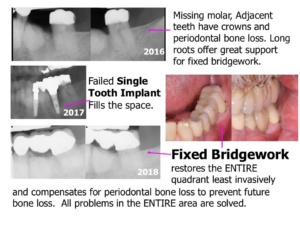
The poster child for this type of thinking is the single tooth implant. In presentations and in publications, rarely does one see a single tooth implant placed among virginal teeth with no fillings, caries or periodontal bone loss—conditions that would justify the placement of a single tooth implant. Instead, the teeth around the implant space have large fillings and crowns—often with decay and periodontal bone loss. These teeth are NOT virginal and will need restorations in the future. The single tooth implant only fills a space and does nothing for the teeth around it. The patient’s problems are never solved. Such treatment is the hallmark of a piecemeal approach to dentistry.
By contrast, bridgework can solve problems in an entire area, preventing recurrent decay, compensating for periodontal bone loss to prevent future bone loss, and redistributing the load to minimize forces on the supporting structures (periodontal bone and roots). Bridgework represents an overall approach in that it is designed to address and prevent future problems.
It is the patients who ultimately suffer. They are not getting the same quality work that their parents received! Often they end up with a hodge-podge of dental treatments that resulted from a lifetime of piecemeal thinking, and their dental problems are never actually solved. Is this progress? I think NOT!
The profession as a whole should seriously consider answering these questions:
- How can practitioners with real evidence convince the profession to exchange a faulty paradigm with one that has a real track record for successful outcome?
- How can the profession be retrained to resist big money interests in favor of what is best for patients?
- How can the profession change the prevailing attitude of “quick-fix-take-the-easy-way-out,” and adopt a precision-based quality mindset?
- How can dentists be trained to think like doctors instead of like mechanical pieceworkers?
Malcolm Gladwell identified the point at which a new idea or paradigm reaches critical mass at the boiling point. He called that threshold “the tipping point.11” Once the tipping point has been breached, a new idea or paradigm spreads like wildfire.
Full coverage restorative dentistry desperately needs to breach a tipping point. But tipping over is not enough to guarantee that the profession will choose the right direction. A new paradigm must prioritize the concept of science for pure inquiry and benefit to humanity. It must also prioritize the best interest of patients over profits. And if advancement in the field is truly destined to be, this MUST happen.

1Lewis, Patrice; “I Wanted to be a Scientist;” WorldNet Daily;
March 6, 2010; https://www.wnd.com/2010/03/127063/.
2https://en.wikipedia.org/wiki/Follow_the_money
3Gargiulo, A. W., Wentz, F. M., & Orban, B. (1961). Dimensions and Relations of the Dentogingival Junction in Humans. Journal of Periodontology, 32(3), 261–267. doi:10.1902/jop.1961.32.3.261; https://sci-hub.se/10.1902/jop.1961.32.3.261
4Ingber, Jeffrey DDS; Rose, Louis F. DDS MD; Coslet, J. George DDS; “The “Biologic Width” – A Concept in Periodontics and Restorative Dentistry;” Alpha Omegan 70(3):62-6; December, 1977.
5 https://microbeonline.com/size-of-bacteria/
6Afify, Ahmed DMD MS, Haney, Stephan DDS, Verrett, Ronald DDS, MS, Mansueto, Michael DDS, MS, Cray, James PhD, and Johnson, Russell DDS, MS; “Marginal discrepancy of noble metaleceramic fixed dental prosthesis frameworks fabricated by conventional and digital technologies;” M J Prosthet Dent; 2018 Feb;119(2):307.e1-307.e7; doi: 10.1016/j.prosdent.2017.08.012. Epub 2017; Nov 15; https://strategygoldmilling.com/documents/Marginal-discrepancy-of-noble-metaleceramic-fixed-dental-prosthesis.pdf https://strategygoldmilling.com/documents/Marginal-discrepancy-of-noble-metaleceramic-fixed-dental-prosthesis.pdf
7Brånemark, Per-Ingvar; with Shu Chien, Hans-Göran Gröndahl, Kingsley Robinson, Barbro K. Brånemark; The Osseointegration Book: From Calvarium to Calcaneus; Quintessenz Verlags-GmbH; 2005.
8Tom Siegfried, “Assumptions are repulsive, especially about gravity;” Science Matters; April 13, 2006.
9Dean, Cordelia; Making Sense of Science: Separating Substance from Spin,
10Dental Abstracts Vol 61, Issue 4; 2016; p.173; Keep the Ones Youve Got; Giannobile, WV, Lang NP: Are dental implants a panacea or should we better strive to save teeth? J Dent Res 95:5-6, 2016.
11Gladwell, Malcolm; The Tipping Point: How Little Things Can Make a Big Difference; Little Brown; 2000; ISBN 9780316316965. P. 12.


You may also like

Some Thoughts on Scientific Peer Review