
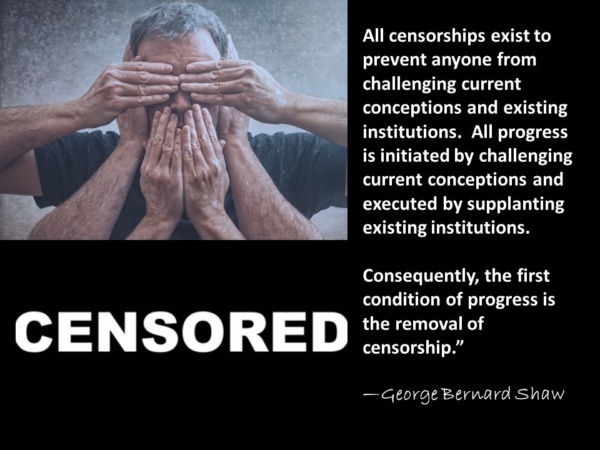
CENSORSHIP in the Dental Profession
Did you know that six companies own 90% of American media? These companies have colluded to censor and control information dispensed to the American public. Independent media have caught them parroting the same talking points verbatim! We should all be outraged because America is supposed to be a beacon of freedom–freedom of speech, freedom of the press, and freedom of worship. Censorship is not allowed by the government, but media companies can come together despite antitrust laws and create “self-censorship.” This week, the news media was all in an uproar about Elon Musk’s purchase of Twitter because he vowed to make that platform a haven for free speech and destroy their narrative.
Censorship has reared its ugly head everywhere, not just in the mainstream media. Take a look at the medical profession. What is in the vaccine?—CENSORED! Doesn’t Ivermectin, a safe antibiotic and anti-parasitic that has been around for decades cure COVID? CENSORED! That is horse medicine!
Do you think the Dental Profession is any better? Dentistry does not exist in a vacuum, and the profession is subject to the prevailing winds of society. Debate on controversial issues in Dentistry is becoming severely restricted. Because I disagree with “official narratives,” I feel like my voice is being silenced. Sometimes censorship is overt; but more often than not it is so subtle that it is almost unnoticeable.
 On one occasion I was interviewed by a famous practitioner with a huge following and social media presence. The host asked me if I would create a course for his teaching website. “Of course, I would love to.” I replied. I was immediately referred to his “Minister of Education” to create the course. The Minister of Education turned out to be a gatekeeper who wanted to control the content. Often gatekeepers do the bidding of corporate sponsors who only care about selling their products for their bottom line. The Minister of Education would not allow me to present any course that featured the use of copper bands. Copper bands can be used not only for impressions but also to fabricate temporary restorations and to create new options for patient treatment. Shouldn’t practitioners have the opportunity to learn techniques that could actually help them in practice? Sadly, the Host–who prided himself on being “anti-establishment”–refused to intervene on my behalf with his “gatekeeper.” What a fake! By condoning censorship on his website he has joined the ranks of the “establishment.”
On another occasion I was asked to write an article for a prosthodontic magazine by a prominent professor who is the Executive Director of an Implant Association. I wrote a beautiful article demonstrating how implant abutments can be combined with precision attachments to restore the dental arch. The article featured cases that were in the mouth as long as twenty years—with X-Rays. I was told that the article would not be printed because “nobody is going to do this.” Don’t readers have a right to know that this kind of case is possible?
Censorship is not usually this overt. In fact, “censorship is most effective when the censor’s hand is invisible;” says David Crowe. “Modern science has developed an effective hierarchy for disseminating ‘acceptable’ information and, perhaps more importantly, for excluding work that threatens mainstream scientists and the governments and industries that fund them.” [David Crowe, “How Scientific Censorship Works;” Alive Magazine; Nov. 2003.] Editors unintentionally become gatekeepers when choosing articles to publish. Peer review systems–designed to help editors choose articles–are not free of bias. Bias is most likely when accepted paradigms are being challenged. Brian Martin in his article “Suppression of Dissent in Science” says that bias through peer review “is difficult to document and…difficult to distinguish from the ‘normal’ operation of science.” [Research in Social Problems and Public Policy, Vol. 7, 1999; http://www.mindfully.org/Reform/Suppression-Dissent-Science.htm.] Many years ago I chaired a project to establish a peer review system for the NY State Dental Journal. Bias was a major concern of that project.
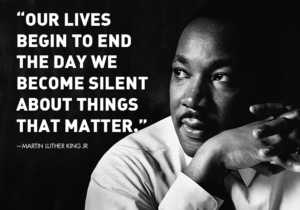 There is also a subtle form of gatekeeping that takes place on academic stages. It is difficult for new voices to be heard on academic stages. I can testify that it has been extremely difficult during the course of my career to obtain speaking engagements–in spite of the fact that I personally know many of the educators and meeting planners involved with staging major meetings. Because I have been extensively involved with meeting planning, I understand quite well that meeting planners need successful turnout in order to make their meetings financially sound. It is not surprising that meeting planners are often loath to take a chance on a speaker who is a relative unknown or who might be considered “controversial.” Meeting planners used to be sticklers that speakers come to their venues without conflicts of interest, but more and more they want those speakers to come with financial sponsorship. What a contradiction!
While it is true that the major meetings send scouts to discover new speakers, scouts inadequately examine speakers for their course contents. As a former scout for the ADA’s Annual Sessions Council, I know that scouts have busy agendas to visit as many speakers as possible. Often, scouts are only in each room for a few minutes; and they focus on superficial details (like the number of attendees in the room) on which to base their recommendations. Sadly, after all the scouting is said and done, the rosters of most conferences ultimately feature the same big names on the “circuit.” Creating rosters in this manner is a subtle form of gatekeeping, which doesn’t provide opportunity for new speakers to challenge accepted paradigms.
Imagine how frustrating this has been for me! I see so many practitioners having difficulty with crown and bridgework. Even large teaching institutions show timidity when it comes to crown and bridgework! I could help so many of these practitioners if only I had access to them! I do not see many presenters showing finished X-Rays or X-Ray follow-up of cases over decades, like I do. I do not know a single presenter with 70 years of documented evidence to show for their techniques. Shouldn’t these facts matter?
 In 1962, Thomas Kuhn, an American physicist and philosopher of science noted in his landmark book “The Structure of Scientific Revolutions,” that we tend to see the world through prisms of paradigms, which he described as “some implicit body of intertwined theoretical and methodological belief that permits selection, evaluation and criticism.” In other words, as Einstein concisely remarked: “we only see what theory allows us to see.” It is amazing to me how often theories become accepted fact without any definitive proof whatsoever! What happens when inconvenient facts refuse to fit the paradigm?
Nothing! Cornelia Dean remarks in her book Making Sense of Science, that “people are unwilling to abandon paradigms that have served them well and the fit well with their core beliefs.” [Cornelia Dean; Making Sense of Science: Separating Substance from Spin; Belknap Press of Harvard University Press; Cambridge, MA; 2017; p. 63-64.] They cling to those paradigms to the bitter end–blindly following them like sheep headed for a cliff.
A new idea seems to follow a distinct pattern says William James, the famous American philosopher, historian and psychologist. First it is condemned as ridiculous; then it is dismissed as trivial. Finally, it becomes “what everybody knows.” But too often clinicians with ground-breaking ideas that challenge existing paradigms are afraid to come forward for fear of ridicule. They keep silent when they should speak out. Avoiding controversial ideas certainly creates popularity; but issues swept under the rug for too long tend to fester.
Lucky for me the internet is a free venue where I can express my ideas. I have a very important message for the profession and it is my mission to give it. While my voice can be hushed by gatekeepers, it cannot be silenced. It is my goal to reach as many practitioners as possible through the ONWARD program so that the prediction of William James comes true for full coverage restorative dentistry. I believe strongly that the tried-and-true techniques and philosophies of the ONWARD program must become “what everybody knows.” When that day arrives the standard of patient care for full coverage restorative dentistry will rise exponentially.
Become the best practitioner in full coverage restorative dentistry that you can be! Don’t settle! Join the ONWARD program and learn how to do crown and bridgework with excellence and confidence, how to save “hopeless” teeth, and how to provide new options for patient treatment that you never thought of. Visit the website and join here: https://theonwardprogram.com/membership/
Dr. Feinberg is also available to give presentations. His CV and speaker packet is posted on the website. Dr. Feinberg can be reached at info@theONWARDprogram.com.

You may also like
Speaking of Dental Speaking…
August 1, 2026

Mentoring
June 1, 2026

Teaching is the Highest Form of Learning
May 1, 2026