
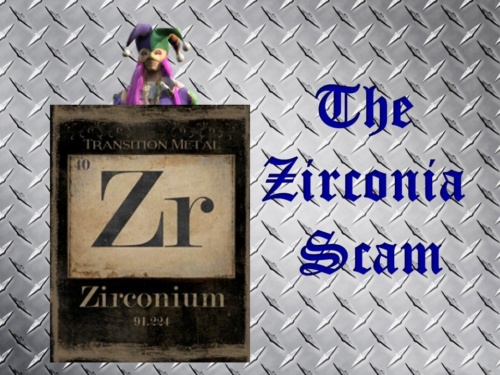
The Zirconia Scam
I like to think of myself as the “Gadfly” of Full Coverage Restorative Dentistry. I know where this area of the profession came from and I am very concerned that even the most seasoned teachers have lost sight of what made full coverage restorative dentistry great. Corporate entities have succeeded in seducing academic institutions and blinding professors and students alike to the truth about many of the new technologies that are being touted as breakthrough innovations. The truth is that many of these “breakthroughs” are not innovations at all–they are conveniences that sacrifice quality and scientific efficacy in the name of economic gain. I strongly believe—as should anyone who believes in science–that anything new coming down the pike MUST be compared to the standard that came before or there is no advancement. Technology may be “cool,” but it is a tool and not an end in itself. At the end of the day dentists are responsible for actual treatment outcomes, not the means by which they arrive at those outcomes.
 One so-called advancement is a material known as Zirconia®. This material came from nuclear power plants and in my opinion belongs there. Zirconia® is being used on an unbelievably wide scale—not because it is better or because comparative evaluation supports its use, but because it is “cheap and white.”
Hands down the best material ever devised for dentistry is gold. All the experts agree on this fact. Therefore, the “gold standard” is the benchmark against which any new material should be measured. It is no secret that most patients do not want to show gold—even though gold is a superior material that can be used on posterior teeth in such a way that the gold doesn’t show. Gold restorations have the best track record in Dentistry and there are patients with gold restorations that have functioned in health for more than five decades.
Porcelain fused to precious metal alloy restorations (PFM) also have a great track record of longevity that can be measured in decades. The metal for fusing porcelain must be an alloy because gold melts at the temperature required to bake the porcelain (except for electrochemically deposited gold). Clinically, all precious or noble metal alloys designed for porcelain have similar properties regardless of gold content. Silver-palladium alloys—which do not contain any gold–have a great track record of success.
So how does Zirconia® measure up? Let’s see.
What is Zirconia®?
Zirconia® is made from the element Zirconium. It is not a ceramic material as some practitioners want to believe. As Dr. Louis Malmacher exclaims: “If you have not figured it out by now, according to the Periodic Table of the Elements, Zirconium (Zr) is a transition metal.” Zirconium exists in great quantities in the earth’s crust, so it is cheap.1 When Zirconium is combined with 3% Yittria, it becomes a strong oxide commonly referred to as “zirconia.” The brand name Zirconia® is a porous matrix containing zirconia and alumina infiltrated by a vitreous phase which is very different from the chemical compound zirconia2.
Zirconia® (ZrO2) exists in three different phases: monoclinic, tetragonal and cubic. Several different oxides are added to zirconia to make Zirconia® to stabilize the tetragonal and/or cubic phases: Magnesia (MgO), Yttria (Y2O3), Calcia (CaO), and Ceria (CeO)2. The oxide powder is hardened by sintering under heat and pressure and formed into blocks. Zirconia® restorations are then milled with CAD/CAM technology.
Zirconia® does have some notable advantages:
-
- High Flexural Strength & Fracture Toughness
- Biocompatibility
- Esthetics
- Cores can be fabricated as thin as .3mm
- More economical than noble metal alloys
So What’s wrong with Zirconia®?
 However, the disadvantages of Zirconia® far outweigh the advantages and render the material totally unsuitable for quality restorative dentistry.
- Zirconia® is extremely difficult to cut with conventional burs: Zirconia is too hard a material to work with. Saridag Sertan and his colleagues from the Department of Prosthodontics at Kocaeli University in Turkey note that Zirconia® has mechanical properties similar to those of stainless steel.3 Its resistance to traction can be as high as 900-1200 MPa and its compression resistance is about 2000 MPa. Dentistry is not lifetime and Zirconia® restorations will most likely require replacement. Removal of these restorations can be quite challenging and can lead to destruction of the underlying tooth structure.
- Zirconia® requires a Butt-Joint Chamfer type Preparation. Robert Winter outlines the ideal preparation for Zirconia® in a newletter issued by the Spear® Institute.4 He says that a .3 to .5mm chamfer allows for a more accurate mill of the pre-sintered zirconia. A chamfer is a circumferential rounded groove inscribed on a tooth with a dental handpiece at the gumline.
Chamfer preparations do not compare favorably to full shoulder preparations. A full shoulder is a circumferential flat ledge that is prepared at the gumline perpendicular to the underlying bone. Full shoulders are better designed to absorb forces and stabilize weak teeth in their sockets. As Dr. Elliot Feinberg notes in his book Full Mouth Restoration in Daily Practice, “the proper use of full coverage procedures employing a full shoulder (preparation eliminates most of the problems now associated with the customary use of full coverage.5
 Zirconia® restorations are also butt-joint restorations. The term butt-joint comes from carpentry, and the Merriam-Webster Dictionary defines it as “a joint made by fastening the parts together end-to-end without overlap and often with reinforcement.6”
The dental profession has known since the 1930s that butt-joint restorations can never be sealed. Bacteria are 2 to 10 microns in size. However clinically accepted marginal gaps range from 50 microns to 200 microns7. This discrepancy might as well be the Grand Canyon to bacteria.
Practitioners expect that cementing and bonding materials will fill the gap. This idea is unscientific, and many cements and bonding materials actually break down in the oral environment. As a result, butt-joint restorations are susceptible to decay, No wonder that Dr. Christiansen says “it is mandatory to use cariostatic cements to provide reduction or elimination of subsequent caries on the crown margins.8”
Butt-joint restorations have inferior fit compared to crowns and bridges made with the Mason Jar Cover concept. In restorations modeled on this concept, the margins extend beyond the ledge onto the root surface in the same manner that a Mason Jar Cover seals a jar against food spoilage. This design compensates for the inaccuracies inherent in the indirect fabrication of crowns and bridges. As a result, there is virtually no recurrent decay, and the type of luting cement used does not matter. Unfortunately, the entire profession has been conditioned by dental institutions and corporate entities to believe that butt-joint restorations are good restorations Historically they NEVER were. Butt-joint restorations did NOT come from Dentistry’s roots and do not compare to the “gold standard” restorations created with Mason Jar Cover design.
 Butt-joint restorations often dislodge from the tooth preparations and require “recementing.” Dr. Gordon Christiansen has stated that he “seldom finds a dentist who has not had Zirconia® crowns come off unexpectedly.” Such a commonplace occurrence demonstrates that cements and bonding are less than desirable luting agents.
If crowns can dislodge, they can leak and decay. Every crown that falls off “unexpectedly” should therefore be remade. By contrast, crowns made with the Mason Jar Cover design do not depend on cement for retention and rarely dislodge. Crowns made with this design fit with precision. There is a big difference between butt-joint restorations that “go on” and Mason Jar Cover designed restorations that “fit.”
- No Standards Exist for Zirconia® Manufacturing: Although all Zirconia® is chemically similar, Zirconia® products vary among
 manufacturers in density, homogeneity, and crystalline structure. Gregg Helvey notes that “the immense popularity of Zirconia® as an indirect restorative material in dentistry has led to seemingly countless numbers of companies selling Zirconia® discs and blocks. The reliability of Zirconia®, however, is subject to specific manufacturing and processing protocols.9” Dr. Christiansen notes that Zirconia® has only been around since 2009 and he refers to Zirconia® as an “evolving” technology.10
- Zirconia® crowns cannot be soldered. According to Arnaud Gilles, some practitioners have said that it is possible to solder Zirconia® crowns together to create bridgework.11 However, most Zirconia® bridges are milled in one piece. If the bridgework does not fit, splitting and reconnecting Zirconia® segments presents major difficulty. By contrast gold and PFM alloys are easily soldered or laser-welded.
Splinting is very important to prevent food impaction and to distribute the load evenly among a group of teeth so that individual teeth do not have to bear the brunt of forces. The use of Zirconia® therefore represents a piecemeal approach to dentistry, where crowns are treated as mere “tooth coverings” for individual teeth. By contrast, crowns and bridges created with an overall concept are designed to bring the forces close to the supporting structures, eliminate or minimize periodontal bone loss, prevent recurrent decay and create an architecture that promotes health.
- The esthetics of Zirconia® is not superior to All-Ceramic Crowns (or even high noble PFM Crowns). All-ceramic
 crowns are butt-joint restorations just like Zirconia® “All ceramic materials more satisfactorily address the demand for esthetic restorations than metal ceramic restorations with opaque cores,” says Arnaud Gilles. “However, the translucency of the most durable zirconia®-based ceramic crowns is reported to be less than that of lithium disilicate glass ceramics, for which excellent esthetic results are documented.8” Dr. Christiansen notes that “full-strength Zirconia® colors are inconsistent from puck to puck. They are made in the Classic Vita colors, not the Vita Master Shade guide colors.” Technicians have to place a thin layer of ceramic on the outside of all Zirconia® crowns to make them the proper color. Unfortunately,” says Dr. Christiansen, “that ceramic wears the enamel on opposing teeth until it wears off. Internal pre-sintered applied colors can eliminate this problem, but this concept needs to be simpler to use and less expensive.12”
- Zirconia® crowns have a relatively high rate of chipping. Arnaud Gilles says “the most common complication observed in Zirconia® -based restorations is fracture of the veneering porcelain, manifesting clinically as chipping fractures of the veneering ceramic with or without exposing the underlying framework.13”
Why is Zirconia® so Popular?
 With all these disadvantages, why has Zirconia® become so popular? There are several reasons why:
-
-
- Overall acceptance of mediocrity as a standard of care
- Inadequate education of dental practitioners in the area of restorative dentistry
- An abundance of patients who want a cheap fix instead of quality work that is more expensive
- Dental Insurance companies that only pay a minimal sum for piecemeal work
- Dental practitioners with huge loans who need to make a “quick buck” and reduce overhead costs
-
The Bottom Line
 Zirconia® is clearly an inferior material that offers no advantages other than economics. It is a scam perpetrated on dental professionals who have no idea about the history of full coverage restorations and know nothing about the incredible track record of gold and precious metal PFM alloys that have been documented for more than a century. The patients have become unsuspecting guinea pigs for the Zirconia® technology that is “evolving.” It should be clear that this technology will NEVER evolve enough to rival what came before. How can anyone in good conscience consider Zirconia® “an advancement?”
The meteoric rise of Zirconia® embodies everything that is wrong with the Dental profession. In choosing to make Zirconia® restorations, practitioners are really choosing economics over science, expediency over evidence, mediocrity over the pursuit of excellence, and piecemeal mechanics above overall health and longevity.
The sudden immense popularity of Zirconia® is quite shocking. In the past Dentistry had academic leaders who stood up for quality and idealism. Today, no one stands up for the truth–especially when profits are blocking the path. The blind acceptance of Zirconia® reflects how dishonest the dental profession has become.

1Malmacher, Dr. Louis; “The Metal-Free Practice Scam;” Dental Economics; October 1st, 2011; https://www.dentaleconomics.com/science-tech/cosmetic-dentistry-and0whitening/article/16394524/the-metalfree-practice-scam
2Arnaud, Gilles; “The Truth About Zirconia,” Dent Tech, vol. 80, no. 81, pp. 59-72.
3Serkan Saridag, Onjen Tak, Gamze Alniacik; “Basic properties and types of zirconia: An overview;” World Journal of Stomatology; ISSN 22818-6263; Baishideng Publishing.Group Co; Pleasnton, CA; Aug. 20, 2013; https://www.wjgnet.com/2218-6263/full/v2/i3/40.htm; doi: 10.5321/wjs.v2.i3.40.
4Winter, Robert; “Posterior Full-Contour Zirconia Crowns: Preparation Design;” https://www.speareducation.com/spear-review/2012/10/posterior-full-contour-zirconia-crowns-preparation-design; October 27,2016.
5Feinberg, Elliot, DDS; Full Mouth Restoration in Daily Practice; J.B. Lippencott, Philadelphia, 1971; p. 1-2.
6https://www.merriam-webster.com/dictionary/butt%20joint
7Annu Eliza James, B. Umamaheswari, C. B. Shanthana Lakshmi, “Comparative Evaluation of Marginal Accuracy of Metal Copings Fabricated using Direct Metal Laser Sintering, Computer‑Aided Milling, Ringless Casting, and Traditional Casting Techniques: An In Vitro Study;” Contemporary Clinical Dentistry; Volume 9, Issue 3; July-September 2018; p. 421-426
8Christiansen, Gordon, “Zirconia® Crowns: The Good and the Bad;” Dec. 9, 2024;
9Helvey, Gregg, DDS MS CDT; “What’s in Your Zirconia?” Compendium;
April 2017; Volume 38, Number 4; pp. 3-6;
https://www.researchgate.net/publication/316716888
10Christiansen, Gordon, “Zirconia® Crowns: The Good and the Bad;” Dec. 9, 2024;
8Arnaud, Gilles; “The Truth About Zirconia,” Dent Tech, vol. 80, no. 81, pp. 59-72.
9Christiansen, Gordon, “Zirconia® Crowns: The Good and the Bad;” Dec. 9, 2024;
11Arnaud, Gilles; “The Truth About Zirconia,” Dent Tech, vol. 80, no. 81, pp. 59-72.
12Christiansen, Gordon, “Zirconia® Crowns: The Good and the Bad;” Dec. 9, 2024;
13Arnaud, Gilles; “The Truth About Zirconia,” Dent Tech, vol. 80, no. 81, pp. 59-72.

You may also like

What’s the Deal With AI?
